
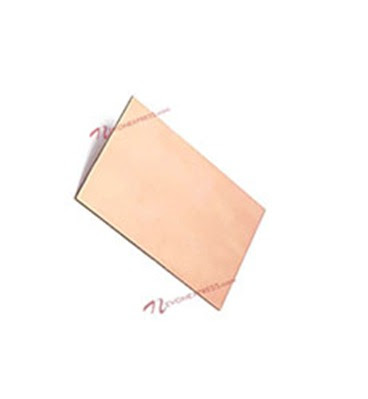
PCB – Printed Circuit Board

 A printed circuit board (PCB) mechanically supports and electrically connects electronic components or electrical components using conductive tracks, pads and other features etched from one or more sheet layers of copper laminated onto and/or between sheet layers of a non-conductive substrate. Components are generally soldered onto the PCB to both electrically connect and mechanically fasten them to it. Printed circuit boards are used in all but the simplest electronic products. They are also used in some electrical products, such as passive switch boxes. Alternatives to PCBs include wire wrap and point-to-point construction, both once popular but now rarely used. PCBs require additional design effort to lay out the circuit, but manufacturing and assembly can be automated. Specialized CAD software is available to do much of the work of layout. Mass-producing circuits with PCBs is cheaper and faster than with other wiring methods, as components are mounted and wired in one operation. Large numbers of PCBs can be fabricated at the same time, and the layout only has to be done once. PCBs can also be made manually in small quantities, with reduced benefits.


Popular posts from this blog

RASPBERRY PI BASED SURVEILLANCE ROBOT BLOCK DIAGRAM

                                       BLOCK DIAGRAM

APPLICATIONS

  1)      Military and aerospace embedded software applications 2)      Communication Applications 3)      Industrial automation and process control software 4)      Mastering the complexity of applications. 5)      Reduction of product design time. 6)      Real time processing of ever increasing amounts of data. 7)      Intelligent, autonomous sensors.

VOLTAGE REGULATOR

FEATURES   • Output Current up to 1A  • Output Voltages of 5, 6, 8, 9, 10, 12, 15, 18, 24V  • Thermal Overload Protection  • Short Circuit Protection  • Output Transistor Safe Operating Area Protection    DESCRIPTION  The LM78XX/LM78XXA series of three-terminal positive regulators are available in the TO-220/D-PAK package and with several fixed output voltages, making them useful in a Wide range of applications. Each type employs internal current limiting, thermal shutdown and safe operating area protection, making it essentially indestructible. If adequate heat sinking is provided, they can deliver over 1A output Current. Although designed primarily as fixed voltage regulators, these devices can be used with external components to obtain adjustable voltages and current